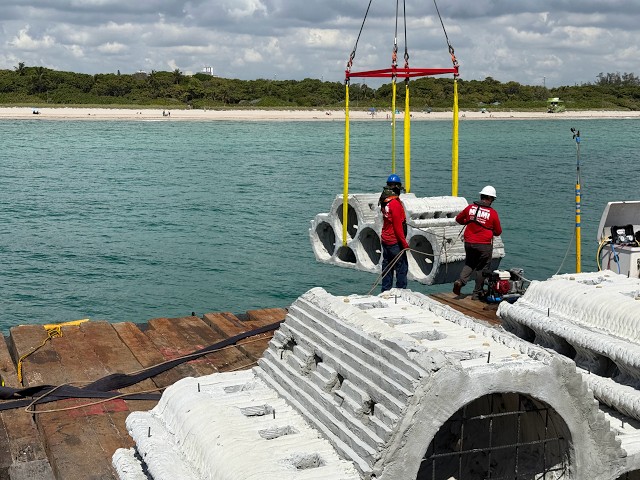
University of Miami researchers dropped three engineered concrete reef structures into the ocean near 81st Street in Miami Beach in July, advancing a project that could one day help protect Miami-Dade's coastline from hurricane waves.
The structures, called SEAHIVEs, cut incoming wave energy by up to 98% in lab testing, according to Landolf Rhode-Barbarigos, an associate professor at UM's College of Engineering who invented the technology in 2018. But at 23 feet long each and sitting about 2,460 feet from shore, the current installation is far too small and distant to stop a real hurricane wave. Researchers themselves describe the Phase 2 structures as "minor speed bumps."
"We showed that this was feasible. To do this on a large scale, you need a large installation," Rhode-Barbarigos told the Miami Herald.
Each SEAHIVE resembles a bundle of rigatoni noodles with holes engineered to let a calculated amount of water flow through, breaking down wave energy in the process. The Phase 2 structures were 3D-printed by 1Print using marine concrete that allows corals to attach more easily.
The real test comes with Phase 3, already in permitting. That deployment will stretch about 330 feet long and sit roughly 660 feet from shore, inside Miami Beach's swim zone. Andrew Baker, director of UM's Coral Reef Futures Lab, said proximity to shore is what matters most for wave protection. No installation date has been announced.
Baker's team seeded the structures with hard corals, including a hybrid of elkhorn and staghorn corals. Both parent species are considered functionally extinct in South Florida, according to Baker, due primarily to climate change-induced marine heat waves. His lab grew 1,000 of the hybrid corals, called fused acropora, using partial military funding. Only two or three fused acropora have ever been found naturally on Florida reefs, Baker said.
Lab testing shows the structures become more effective as corals grow on their exterior, meaning protection increases over time.
The technology has no announced deployment plans for Biscayne Bay's western shoreline, where Palmetto Bay and Cutler Bay sit. But the stakes for Miami-Dade's coast are clear: A U.S. Geological Survey study found that continued coral reef degradation could increase annual flood damages to buildings by $412 million countywide and raise flood risk to residents by 42%. The county has recorded $854.9 million in flood insurance claims since 1978, according to USGS data.
The U.S. Army Corps of Engineers, Florida Department of Transportation and international clients have expressed interest in the SEAHIVE technology, according to the Miami Herald. Additional installations exist in North Florida, with another planned for Jupiter.





.jpg)